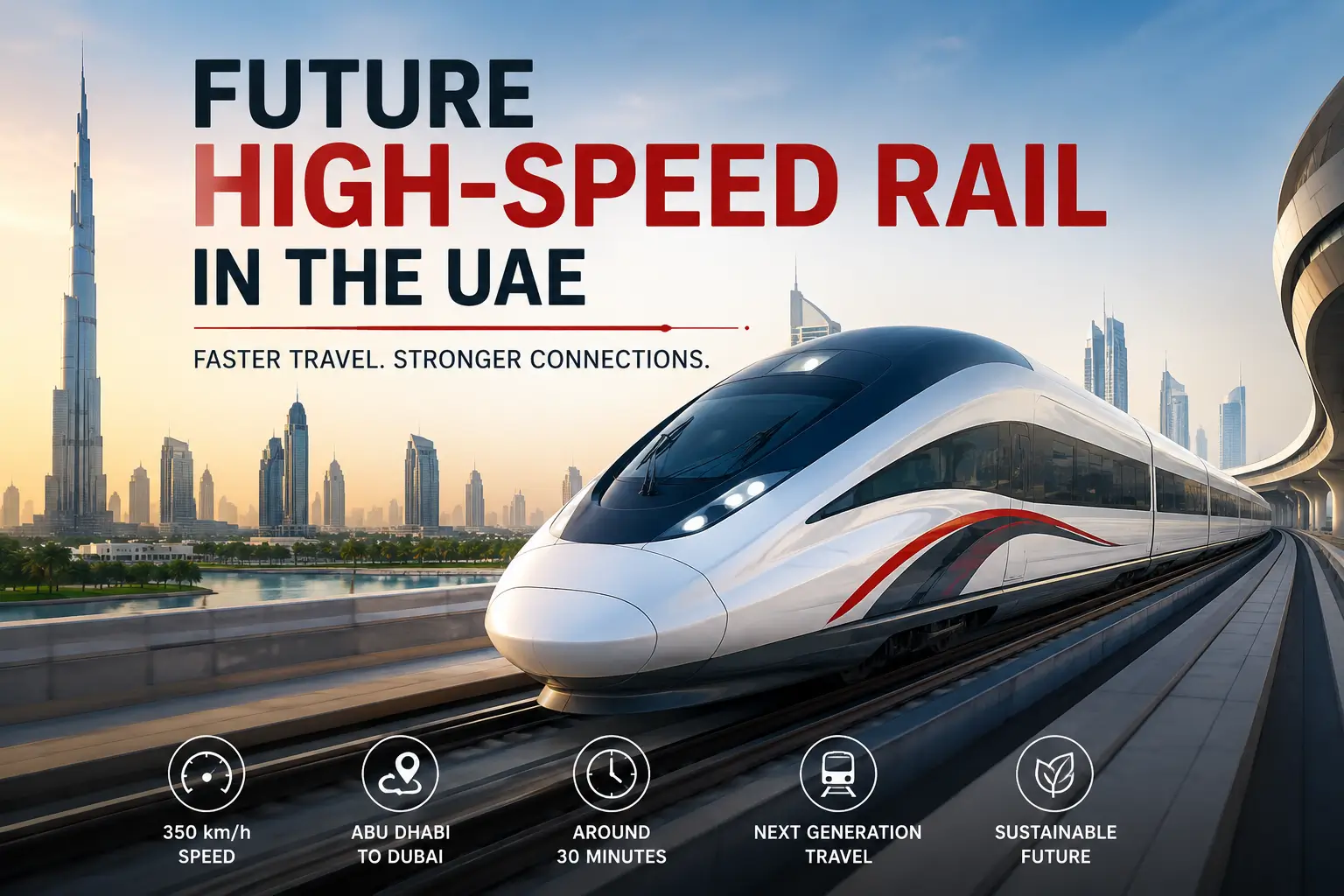
The Future High-Speed Rail in the UAE project represents the next stage in the country's transportation development. Following the launch of the Etihad Rail passenger network, the UAE is planning an advanced high-speed rail system that could dramatically reduce travel times between the country's largest cities while supporting economic growth, tourism, and sustainable mobility.
Although the project is still under development, government announcements indicate that a dedicated high-speed railway will complement the existing Etihad Rail network rather than replace it. The future line is expected to connect major urban centers with trains capable of operating at significantly higher speeds than conventional passenger services.
Overview of the UAE High-Speed Rail Project
The UAE has announced plans to build one of the fastest rail networks in the Middle East. The proposed high-speed railway is designed to provide rapid intercity transportation between key economic hubs, making travel faster, more convenient, and environmentally friendly.
Unlike the current Etihad Rail passenger trains, which are designed for mixed passenger and freight operations, the future high-speed line is expected to be built specifically for passenger transport using dedicated infrastructure.
Key objectives include:
- Faster travel between Abu Dhabi and Dubai
- Reduced road congestion
- Lower carbon emissions
- Improved connectivity for residents and tourists
- Support for economic diversification under the UAE's long-term development strategy
Planned Route
Current plans focus on connecting the country's two largest cities:
- Abu Dhabi
- Dubai
Future extensions may connect additional emirates and major destinations if demand continues to grow.
Potential future destinations include:
- Sharjah
- Ajman
- Ras Al Khaimah
- Fujairah
- Al Ain
However, these extensions have not yet been officially confirmed.
Expected Train Speed
The future high-speed trains are expected to reach speeds of up to 350 km/h (217 mph), making them considerably faster than conventional passenger rail services.
At these speeds, the journey between Abu Dhabi and Dubai could take approximately 30 minutes, depending on the final route and the number of intermediate stops.
Travel Time Comparison
| Route | Current Road Travel | Future High-Speed Rail |
|---|---|---|
| Abu Dhabi – Dubai | 70–90 minutes | Around 30 minutes |
| Dubai – Abu Dhabi Airport | Over 1 hour by road | Significantly reduced |
| Major city connections | Subject to traffic | Consistent travel times |
Actual travel times will depend on the final operating schedule and station locations.
High-Speed Rail vs Etihad Rail
Many travelers wonder whether the future high-speed railway is the same as Etihad Rail.
The answer is no.
| Etihad Rail | Future High-Speed Rail |
|---|---|
| Mixed passenger and freight network | Passenger-only system |
| Maximum passenger speed around 200 km/h | Expected speed up to 350 km/h |
| Connects multiple cities across the UAE | Initially focused on Abu Dhabi–Dubai |
| Conventional railway | Dedicated high-speed railway |
Both networks are expected to operate together, providing different travel options for passengers.
Proposed Stations
The final station locations have not yet been officially announced.
Based on current information, major stations are expected to be located near:
- Abu Dhabi city
- Dubai city
- Major business districts
- Key transport hubs
- International airports
The exact locations will be confirmed as the project progresses.
Benefits for Passengers
Faster journeys
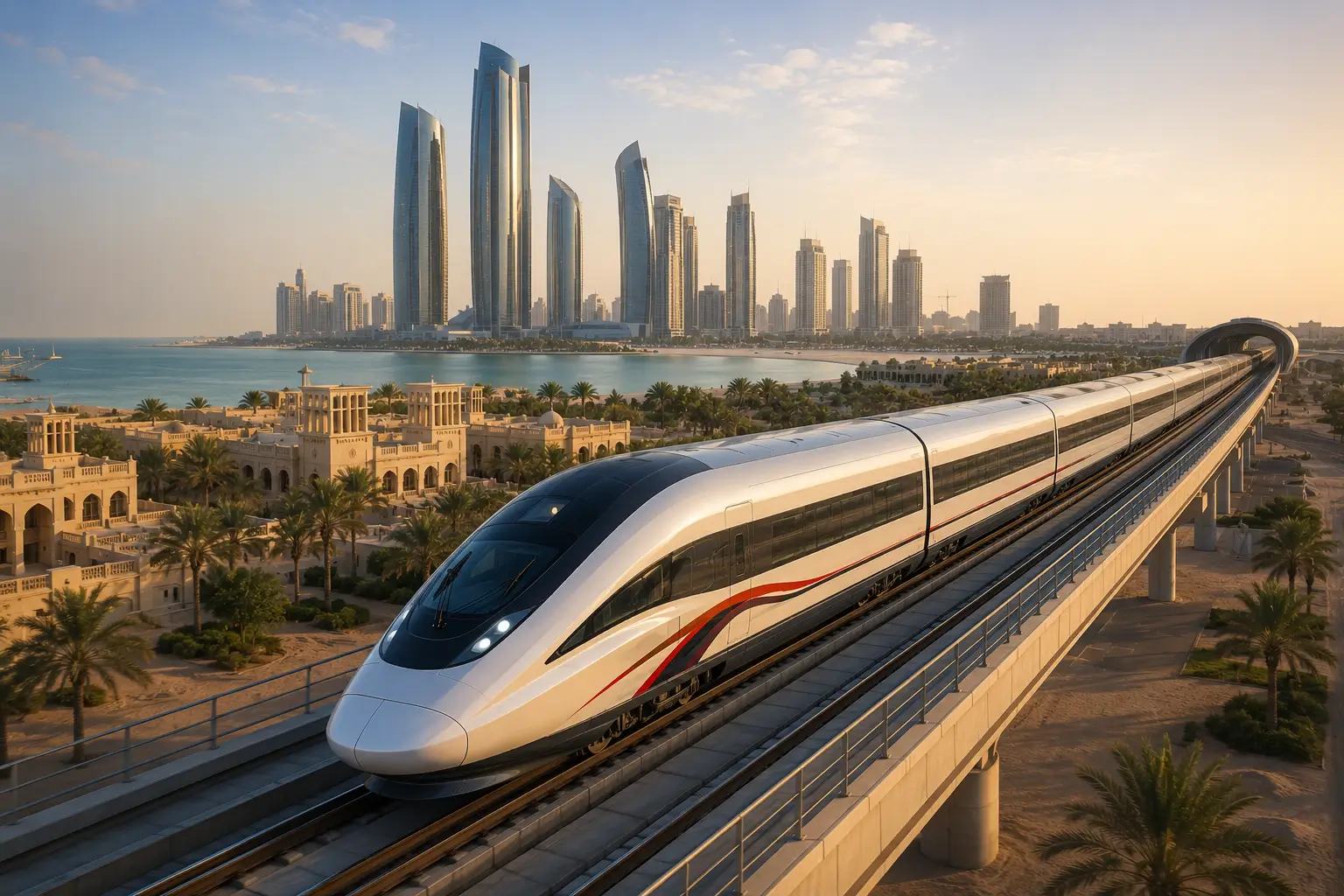
Passengers will be able to travel between Abu Dhabi and Dubai in roughly half an hour.
Reliable schedules
Unlike driving, trains are not affected by highway traffic congestion.
Comfortable travel
Modern high-speed trains typically provide:
- Spacious seating
- Wi-Fi
- Power outlets
- Luggage storage
- Accessibility features
- Business-class options
The final onboard services will be announced closer to launch.
Sustainable transportation
High-speed rail produces lower emissions per passenger compared with private vehicles and short domestic flights, supporting the UAE's sustainability goals.
Economic Impact
The high-speed rail project is expected to generate significant economic benefits by:
- Encouraging tourism between emirates
- Improving business travel
- Supporting real estate development near stations
- Creating new jobs during construction and operation
- Strengthening regional connectivity
The railway will also contribute to the UAE's vision of becoming a global transportation and logistics hub.
Project Status
The UAE government has announced the high-speed rail initiative, but construction timelines, station locations, ticket prices, and opening dates have not yet been officially confirmed.
As more information becomes available, this page will be updated with:
- Official route maps
- Confirmed stations
- Ticket prices
- Construction progress
- Expected opening date
- Train specifications
Frequently Asked Questions
Is the UAE building a high-speed railway?
Yes. The UAE has announced plans for a dedicated high-speed passenger rail network that will complement the existing Etihad Rail system.
How fast will the trains be?
The planned trains are expected to operate at speeds of up to 350 km/h.
How long will the Abu Dhabi to Dubai journey take?
The expected travel time is approximately 30 minutes, depending on the final route and operating schedule.
Is the project already operating?
No. The high-speed railway has been announced but is not yet in operation.
Will the high-speed railway replace Etihad Rail?
No. The high-speed network is expected to operate alongside Etihad Rail, serving different transportation needs.
Conclusion
The Future High-Speed Rail in the UAE has the potential to transform intercity travel by connecting major destinations with fast, reliable, and sustainable transportation. Once completed, the network is expected to become one of the fastest passenger rail systems in the region, reducing travel times, supporting tourism, and strengthening the UAE's modern transport infrastructure. As official details are released, passengers can expect more information about routes, stations, ticketing, and launch dates.