Dubai – Abu Dhabi in 30 Minutes: UAE High-Speed Train
The United Arab Emirates is entering a new era of rail transportation. In 2026, Etihad Rail moved from preparation to passenger operations, with trains connecting Abu Dhabi and Fujairah since June and the passenger network expanding to Dubai and Al Dhaid in Sharjah on 30 September 2026. At the same time, the UAE is developing a separate high-speed rail project designed to dramatically shorten travel between Dubai and Abu Dhabi.
design speed of the high-speed line
planned high-speed journey time
current Etihad Rail journey time
target completion of the high-speed line
It is important to distinguish between these two projects. Etihad Rail passenger services are already operating and are being expanded across the UAE. The future high-speed railway between Dubai and Abu Dhabi is a separate project designed for much higher speeds and a journey time of around 30 minutes.
Dubai is becoming one of the key elements of this new transport system. The emirate is now connected to the national Etihad Rail passenger network through Dubai Al Yalayis Station, while future railway infrastructure is expected to connect high-speed services with Dubai’s urban transport network.
This means that the UAE’s railway development is taking place on several levels at the same time: the existing Etihad Rail passenger network provides intercity connections between the emirates, while the planned high-speed railway is intended to create a much faster connection between the country’s two largest cities.
| Feature | Etihad Rail passenger train (today) | High-speed railway (future) |
|---|---|---|
| Status | Operating since 30 September 2026 | Under construction, target completion 2031 |
| Dubai station | Dubai Al Yalayis (Jumeirah Golf Estates) | Al Jaddaf (planned) |
| Abu Dhabi station | Mohammed Bin Zayed City | Al Zahiyah, Saadiyat Island, Yas Island and Abu Dhabi International Airport (planned) |
| Journey time | About 64 minutes | About 30 minutes |
| Speed | Up to 200 km/h | Designed for 350 km/h, operating up to 320 km/h |
| Fares | From AED 39 (Comfort) / AED 109 (Premium) | Not yet announced |
A High-Speed Train Capable of 350 km/h
One of the most ambitious elements of the UAE’s rail expansion is a dedicated high-speed railway between Dubai and Abu Dhabi. Unlike the current passenger services operated as part of the national Etihad Rail network, this project is designed specifically for very high-speed intercity travel.
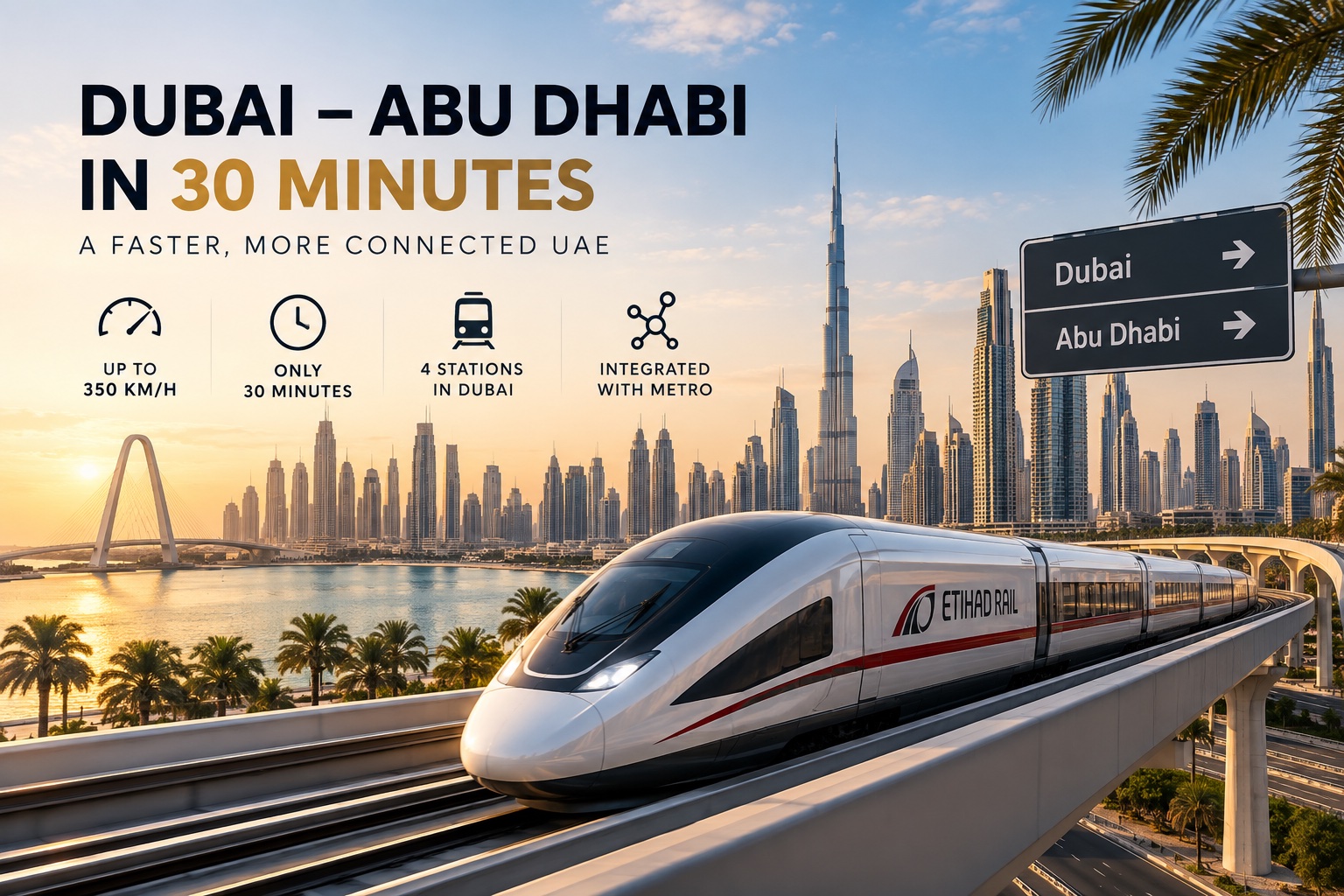
According to the plans announced for the project, high-speed trains will be capable of reaching up to 350 km/h, while the journey between Dubai and Abu Dhabi is expected to take around 30 minutes.
The high-speed service should not be confused with the current Dubai–Abu Dhabi Etihad Rail passenger train. Passengers can already travel between the two cities by rail, but the existing service takes around 64 minutes according to the published timetable. The 30-minute journey refers to the separate future high-speed railway project.
Announced Project Parameters
The main announced parameters of the future high-speed project include:
- Maximum train speed of up to 350 km/h.
- Planned Dubai–Abu Dhabi journey time of around 30 minutes.
- A dedicated high-speed railway developed separately from the current passenger service.
- Two planned high-speed stations in Dubai — Al Jaddaf and Al Maktoum International Airport.
Latest Project Details
- Total line length of about 150 km.
- Design speed of 350 km/h, with trains operating at up to 320 km/h.
- Construction has started on the 96.9 km Abu Dhabi section, including an 11.2 km twin-bore tunnel.
- Planned stations include Al Zahiyah, Saadiyat Island, Yas Island, Abu Dhabi International Airport and Al Jaddaf.
- Completion is targeted for 2031.
If implemented as planned, the project could significantly change the way passengers travel between Dubai and Abu Dhabi. A journey that currently takes considerably longer by road or around an hour by the existing passenger railway could eventually become a short high-speed rail trip.
How the Dubai–Abu Dhabi Train Works Today
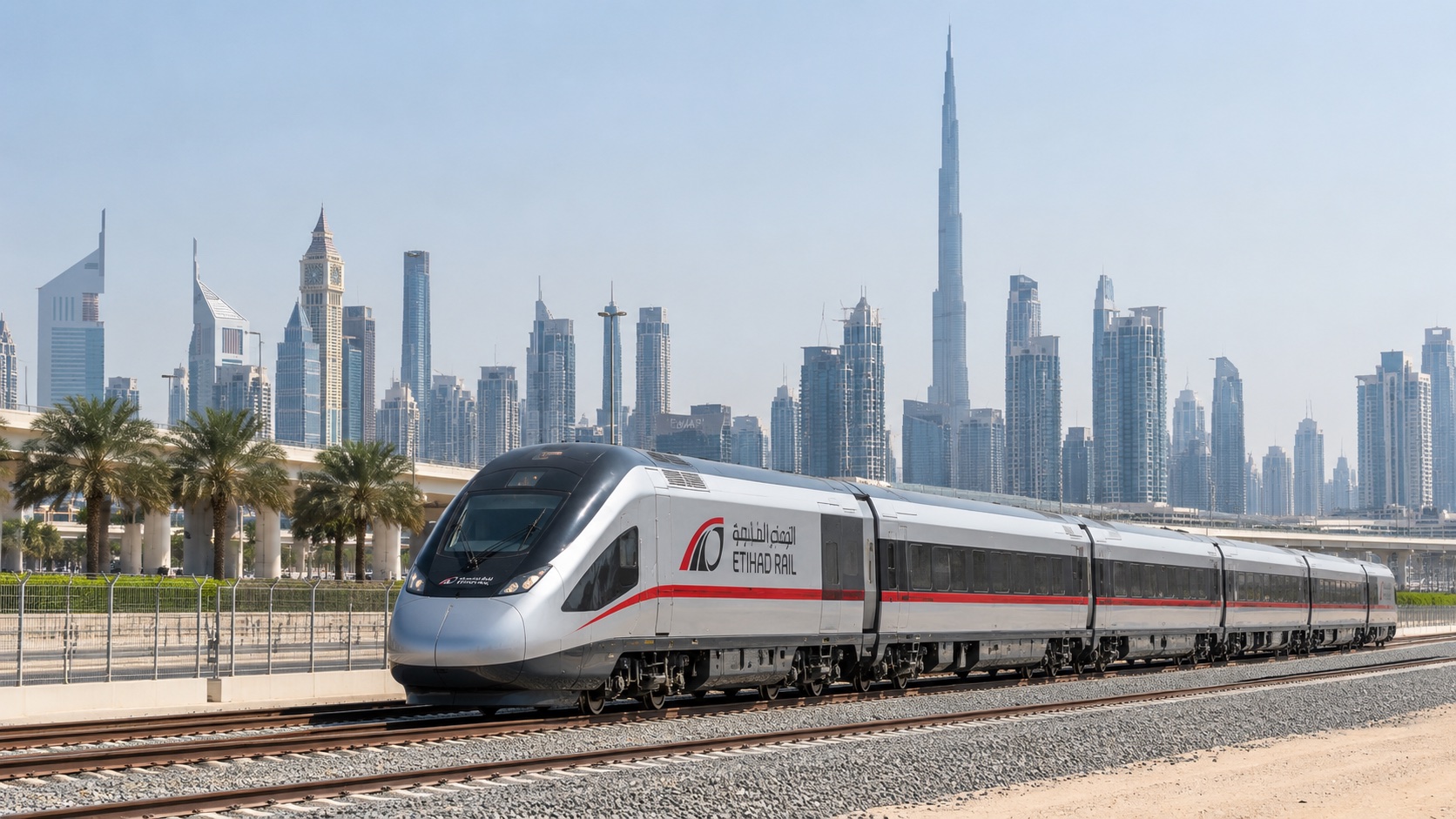
While the high-speed railway remains a future project, passengers can already travel between Dubai and Abu Dhabi using Etihad Rail. Dubai’s first passenger railway station, Dubai Al Yalayis, began passenger operations on 30 September 2026.
The route connects Dubai Al Yalayis Station, located near Jumeirah Golf Estates, with Mohammed Bin Zayed City Station in Abu Dhabi. The published timetable shows a journey time of approximately 64 minutes, with five trains a day in each direction.
Comfort Class
Premium Class
Tickets for the Dubai–Abu Dhabi route start from AED 39 in Comfort Class, while the published starting fare for Premium Class is AED 109. The final price depends on the selected train, travel date and fare type.
The current Etihad Rail service therefore already provides a direct railway connection between Dubai and Abu Dhabi. The future 30-minute train represents a further stage in the development of high-speed rail in the UAE rather than a replacement for the existing passenger service.
Dubai Al Yalayis Station Is Now Part of the Passenger Network
Dubai Al Yalayis Station is the first passenger railway station of the national Etihad Rail network in Dubai. Located near Jumeirah Golf Estates, it provides direct rail connections between Dubai and destinations including Abu Dhabi and Fujairah.
One of the station’s most important features is its connection to Dubai’s urban transport system. Dubai Al Yalayis is linked to Jumeirah Golf Estates Metro Station on the Dubai Metro Red Line by a dedicated covered pedestrian bridge of 375 metres, which opened on 15 October 2026 and takes about five minutes to walk.
This connection allows passengers to combine rail and metro travel in a single journey. Travellers can use Dubai Metro to reach the railway station, continue to another emirate by Etihad Rail and then use local transport after arriving at their destination.
The transport integration is also being developed through Dubai’s Nol system, which supports connections between Etihad Rail and Dubai’s public transport network, including metro, tram and bus services. A combined Etihad Rail and Dubai Metro journey can already be booked as a single transaction with one QR code.
Other Etihad Rail Passenger Routes Already Operating
The development of passenger rail services is not limited to the Dubai–Abu Dhabi route. Etihad Rail began passenger operations between Abu Dhabi and Fujairah on 30 June 2026, and the network expanded to Dubai and Al Dhaid in Sharjah on 30 September 2026.
With the opening of Dubai Al Yalayis, passengers can also travel between Dubai and Fujairah by train. The published journey time is approximately 70 minutes, with fares starting from AED 29 for Comfort Class and AED 89 for Premium Class.
The national passenger network is being expanded in stages. Al Dhaid in Sharjah has been open since 30 September 2026, and stations in Al Dhafra and a second Sharjah station are scheduled to join the network over the following months, with the current first-phase network expected to reach ten stations by March 2027.
| Date | Stations | Status |
|---|---|---|
| 30 June 2026 | Abu Dhabi (Mohammed Bin Zayed City), Fujairah | Open |
| 30 September 2026 | Dubai (Al Yalayis), Al Dhaid (Sharjah) | Open |
| 30 November 2026 | Madinat Zayed, Liwa (Al Dhafra) | Planned |
| 30 December 2026 | Al Mirfa, Al Dhannah, Al Sila (Al Dhafra) | Planned |
| 30 March 2027 | University City (Sharjah) | Planned |
Planned dates as announced by Etihad Rail and reported by UAE media in October 2026. Opening dates may change.
Four Railway Stations Planned for Dubai
Dubai is gradually developing a multi-level railway system that will combine national passenger services with future high-speed connections. Current plans identify four railway stations linked to the Etihad Rail network, with different roles within the wider transport system.
Dubai Al Yalayis
Dubai Al Yalayis is already part of the national Etihad Rail passenger network. The station is located near Jumeirah Golf Estates and provides a direct pedestrian connection to the Dubai Metro Red Line.
Meydan
A second station for the national Etihad Rail passenger network is planned in the Meydan area. Its development is connected to Dubai’s future public transport infrastructure, including the planned Gold Line interchange.
Al Jaddaf and Al Maktoum International Airport
The remaining two stations — Al Jaddaf and Al Maktoum International Airport — are planned to serve the future high-speed railway connecting Dubai and Abu Dhabi.
A Multi-Level Network
The result will be a railway system in Dubai that combines national intercity passenger services with a separate high-speed corridor designed for significantly faster travel between the two major emirates.
Rail and Dubai Metro Designed to Work Together
The development of new railway infrastructure is not simply about adding more train routes. A key objective is to create a more integrated transport network in which national rail services, future high-speed trains and the Dubai Metro complement one another.
Dubai Al Yalayis already demonstrates this approach. The station is directly connected to Jumeirah Golf Estates Metro Station through a covered pedestrian bridge, allowing passengers to transfer between Etihad Rail and Dubai Metro without relying entirely on road transport.
Future railway stations are also being planned with Dubai’s expanding metro network in mind. The planned Meydan station, for example, is expected to provide an interchange with the future Gold Line, while Al Jaddaf is already connected to the existing Dubai Metro network through the Green Line.
For passengers, this could mean a simpler travel experience: use the metro to reach a railway station within Dubai, transfer to a national or high-speed train, and continue the journey to another emirate.
Al Jaddaf and the Future of Dubai’s Rail Network
Al Jaddaf is expected to play an important role in Dubai’s future high-speed railway system. One of the planned high-speed stations will be located in the area as part of the future connection between Dubai and Abu Dhabi. Under the published plans, Al Jaddaf station is designed as an underground station, and the high-speed journey between Yas Island and Al Jaddaf is expected to take about 30 minutes.
The area is already served by the Dubai Metro Green Line, providing an existing connection to the city’s public transport network. The planned high-speed station would therefore form part of a broader strategy to connect intercity rail with local transportation.
The location also illustrates how Dubai’s railway planning is increasingly focused on integrating different forms of transport rather than developing each system independently.
What Will Happen to the Dubai–Abu Dhabi Train in the Future?
The development of two different types of rail service means that passengers could eventually have a choice between the national Etihad Rail passenger network and a much faster high-speed service.
The existing Etihad Rail network is designed to connect multiple regions and emirates across the UAE. The future high-speed railway, by contrast, is intended to provide the fastest possible connection between major economic and population centres, particularly Dubai and Abu Dhabi.
The future 30-minute train should therefore not be viewed as a replacement for Etihad Rail. Instead, it would add another level of passenger rail service to the UAE’s wider transportation system.
This distinction is important for travellers searching for a Dubai–Abu Dhabi train today. The Etihad Rail service is already available, while the 30-minute high-speed journey remains part of the future railway development plans, with completion targeted for 2031.
Why High-Speed Rail Could Change Travel Between the Emirates
The route between Dubai and Abu Dhabi is one of the most important intercity travel corridors in the UAE. Residents, tourists and business travellers regularly move between the two cities, with road transport currently accounting for a significant share of these journeys.
The existing Etihad Rail passenger service provides a new alternative to driving, while the planned high-speed train would introduce a significantly faster option. With a maximum planned speed of up to 350 km/h and a target journey time of around 30 minutes, the future service is designed specifically for rapid intercity travel.
The overall usefulness of the high-speed railway will depend not only on the train’s speed, but also on station locations, connections with metro and other public transport, frequency of services and ticket prices.
RailX Dubai and the Future of Rail Technology
The expansion of the UAE’s railway infrastructure is also attracting increasing attention from the international transport and technology sectors. RailX Dubai is one of the industry events associated with the development of rail transportation and mobility in the region.
The exhibition and conference brings together transport professionals, technology companies, infrastructure specialists and other industry participants to discuss investment, railway technology, infrastructure development and the future of rail transportation in the Middle East.
For the UAE, this growing international interest comes at a time when the country is moving from railway construction and planning towards a much larger passenger rail network and new high-speed transportation projects.
A New Chapter for UAE Transportation
In 2026, the UAE’s railway system moved from preparation into real passenger operations. Etihad Rail has already launched passenger services, and Dubai Al Yalayis has become part of the national passenger network.
The next major stage could be the development of the high-speed railway between Dubai and Abu Dhabi. The announced parameters — speeds of up to 350 km/h and a journey time of around 30 minutes — are significantly different from the current Etihad Rail passenger service.
At the same time, Dubai is integrating railway infrastructure with its metro and wider public transport network. The result is a multi-level transport system in which national passenger trains, future high-speed rail and urban metro services are designed to complement one another.
For travellers today, the Dubai–Abu Dhabi Etihad Rail service is already a real passenger option, with trains operating between Dubai Al Yalayis and Mohammed Bin Zayed City Station. The approximately 30-minute journey belongs to the future high-speed rail project.
As further official information becomes available about the construction timeline, stations, service frequency, ticket prices and launch date of the high-speed railway, the details of the project will become clearer. Until then, Etihad Rail’s existing passenger services represent the current stage of the UAE’s expanding railway network.
Frequently Asked Questions
Can I travel from Dubai to Abu Dhabi in 30 minutes by train today?
No. The 30-minute journey refers to the future high-speed railway, which is targeted for completion in 2031. Today’s Etihad Rail passenger train between Dubai Al Yalayis and Mohammed Bin Zayed City takes about 64 minutes.
How fast will the UAE high-speed train be?
The line is designed for 350 km/h, with trains expected to operate at up to 320 km/h.
When will the Dubai–Abu Dhabi high-speed railway open?
Construction has started on the Abu Dhabi section, and completion is targeted for 2031. An exact opening date has not yet been announced.
Where will the high-speed train stop?
Published plans include Al Zahiyah, Saadiyat Island, Yas Island and Abu Dhabi International Airport in Abu Dhabi, and Al Jaddaf in Dubai. Al Maktoum International Airport has also been named as a planned high-speed station in Dubai.
How much does the current Dubai–Abu Dhabi train cost?
Etihad Rail fares start from AED 39 in Comfort Class and AED 109 in Premium Class, one way. High-speed fares have not yet been announced.
Will the high-speed train replace Etihad Rail?
No. The high-speed railway is a separate project that will add a faster option between Dubai and Abu Dhabi, while the Etihad Rail network continues to connect multiple emirates and regions.
Plan a journey today with our guides to the Dubai to Abu Dhabi train, Dubai Al Yalayis Station, Abu Dhabi Station and the UAE train live schedule.
Information is based on Etihad Rail announcements and UAE and international media reports as of October 2026. High-speed rail plans, station locations and timelines may change.